On This Day - 7th September

2015

The Recreated ZX Spectrum launches

The Recreated ZX Spectrum, produced by Elite Systems, launches as a modern recreation of the original Sinclair ZX Spectrum.

Designed to the same size as the 48K Spectrum and featuring its distinctive 40-key rubber keyboard, the new device was not a complete computer in its own right. Instead, it operated as a Bluetooth and USB keyboard and controller, working with accompanying software running on phones, tablets, PCs, Macs and connected televisions.

The project had originally been announced as the Bluetooth ZX Spectrum and was funded through a Kickstarter campaign running from December 2013 to January 2014. The campaign raised £63,194 from 821 backers, exceeding its £60,000 target.

The accompanying software included Sinclair BASIC and a selection of licensed Spectrum games, allowing the recreated keyboard to be used for both programming and playing Spectrum software.

The project was produced by Elite Systems, a company with its own history in the ZX Spectrum era. Its co-founder Steve Wilcox had been involved with Elite since the company's formation in 1984
Source: Elite Systems; Kickstarter; Centre for Computing History; contemporary launch reports.
The Kickstarter campaign dates from December 2013–January 2014, while the completed product was publicly launched on 7 September 2015. The Centre for Computing History records 17 September 2015 for its museum exhibit, so 7 September is being used here specifically as the commercial launch date.

Also in this month

Other historical information recorded for September.

1971

Kenbak-1 goes on sale

The Kenbak-1, designed by John V. Blankenbaker, goes on sale in the United States, becoming one of the earliest commercially available personal computers.

Designed in 1970 and built before microprocessors were available, the Kenbak-1 used small- and medium-scale integrated circuits to create an 8-bit computer on a single circuit board. It contained just 256 bytes of memory and was programmed using switches on the front panel, with the results displayed using a row of lights.

The machine was marketed primarily as an educational computer for learning programming and computer concepts. It sold for $750, making it possible for an individual or educational institution to purchase a complete programmable computer rather than having to use a large shared mainframe.

The Kenbak-1 was not a conventional home computer by later standards. It had no keyboard, screen, cassette interface or microprocessor, and only around 40 machines were sold before the Kenbak Corporation ceased trading in 1973.

Nevertheless, the Kenbak-1 became an important milestone in the history of personal computing. In 1986, the Boston Computer Museum held a competition to identify the earliest personal computer and awarded first place to the Kenbak-1. The Computer History Museum continues to describe it as one of the earliest personal computers.
Source: Computer History Museum; John V. Blankenbaker / Kenbak-1 historical records.
Initial Kenbak-1 sales commenced in September 1971. The surviving historical evidence supports the month rather than a specific day, so this entry deliberately uses September rather than assigning a potentially inaccurate exact date.
1981

Commodore VIC-20 launched in the UK

Commodore brings the VIC-20 to the British market, providing a major new competitor for Sinclair's rapidly growing ZX81. The colour home computer had originally appeared in Japan as the VIC-1001 and was subsequently introduced internationally as the VIC-20.

The VIC-20 was based around the MOS 6502 processor and included 5K of RAM, of which approximately 3.5K was available to BASIC programs. Despite its modest memory, the machine offered colour graphics and sound, making it particularly attractive for games and home entertainment. It could be connected to a television and used standard cassette tapes for program and data storage.

In Britain the VIC-20 was initially priced at around £200, considerably more than Sinclair's £69.95 ZX81 but offering colour graphics, sound, a full-size keyboard and a substantially more conventional computer experience. Commodore marketed it as a friendly and accessible computer rather than simply a machine for electronics enthusiasts.

The arrival of the VIC-20 added another important competitor to Britain's rapidly expanding home-computer market. Commodore's machine competed directly with Sinclair, Acorn, Tandy and other manufacturers and helped establish the idea that an inexpensive home computer could combine programming, education and video gaming.

The VIC-20 went on to become one of the most successful early home computers, eventually selling more than 2.5 million units worldwide. It was also the first computer to sell more than one million units, an important milestone in the development of the mass-market home-computer industry.
Source: Computing Today, September 1981; Your Computer, August/September 1981; Centre for Computing History VIC-20 catalogue.
Commodore's UK launch campaign for the VIC-20 appeared in Computing Today, September 1981, with the advertisement “VIC-20: The Waiting is Over. The Rush has Begun.” Contemporary UK computer magazines were already reviewing and reporting on the machine in August/September 1981. The VIC-20 had previously been introduced in Japan as the VIC-1001 in 1980. The UK launch price was £199.
Sinclair launches ZX Interface 2
1983

Sinclair launches ZX Interface 2

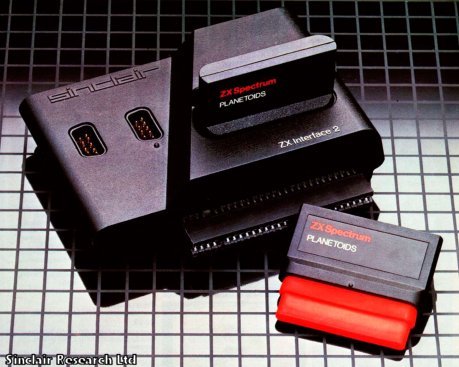
Sinclair Research launches the ZX Interface 2 for the ZX Spectrum. The new peripheral was designed primarily for computer games, providing two joystick connections and a slot for ROM cartridges that allowed compatible software to start almost instantly without the loading time associated with cassette tape.

The Interface 2 was priced at £19.95 and was launched alongside a range of ten ROM cartridge games. These included Sinclair titles such as Space Raiders, Planetoids, Hungry Horace, Horace and the Spiders, Chess and Backgammon, together with Ultimate Play The Game titles including Pssst, Jetpac, Cookie and Tranz Am.

The two joystick ports used Sinclair's own keyboard-mapped interface rather than the already popular Kempston standard. The first joystick was mapped to keys 6–0 and the second to keys 1–5. Consequently, many existing Spectrum games could not use the Interface 2 joysticks unless they provided configurable controls.

The ROM cartridge system was technically interesting but commercially unsuccessful. Cartridges were limited to 16K of ROM and initially cost £14.95 each, considerably more than many cassette games. Only ten commercially released cartridges appeared, making the Interface 2 one of Sinclair's shortest-lived major Spectrum peripherals.

The Interface 2 also provided a reduced pass-through connector at the rear, intended to allow a ZX Printer to remain connected. Despite the limited success of the ROM cartridge system, its joystick interface remained significant and was supported by later Spectrum software and machines.
Source: Popular Computing Weekly, 4–10 October 1983, contemporary report headed “Sinclair Launches Interface 2”. It states that the Interface 2 made its first public appearance at the Personal Computer World Show and gives the £19.95 price and details of the ten
Sinclair Interface 2 first appeared publicly at the Personal Computer World Show in September 1983. It provided two joystick ports and a ROM cartridge slot and launched with ten cartridge games at £14.95 each. Contemporary sources establish September 1983, but I have not found evidence for a specific day.
1983

BBC launches its Telesoftware service

The BBC launches its Telesoftware service, allowing computer programs to be broadcast through the BBC's Ceefax teletext system.

Instead of broadcasting only pages of information for people to read, special teletext pages could contain computer programs encoded as data. A suitably equipped computer could receive the pages through a television aerial, decode the data and store the resulting program in memory or on cassette or disk.

The BBC's service initially concentrated on the BBC Micro, with software aimed particularly at schools, education and home users. Programs could be transmitted alongside ordinary Ceefax pages without requiring a separate telephone connection.

Telesoftware represented a remarkable new way of distributing computer software. A broadcaster could transmit the same program simultaneously to thousands of homes, turning the television network into a form of software-distribution system.

The technology would soon become relevant to other home computers. ZX Spectrum users could use teletext adapters such as the OEL/Volex TTX 2000 series, and by late 1984 the BBC was conducting trials of software broadcasts specifically for the Spectrum via Ceefax.

The BBC Telesoftware service therefore represents an early form of over-the-air software downloading, decades before broadband Internet made downloading software commonplace.
Source: BBC; BBC Engineering; Teletext Museum; contemporary computing publications.
The BBC Telesoftware service officially came into operation in September 1983. Contemporary sources describe it as the world's first regular broadcast service for computer programs. An earlier experimental telesoftware broadcast had been made by ITV ORACLE in February 1977, but there was no practical receiving equipment available at the time.
ZX Spectrum 128K launched in Spain
1985

ZX Spectrum 128K launched in Spain

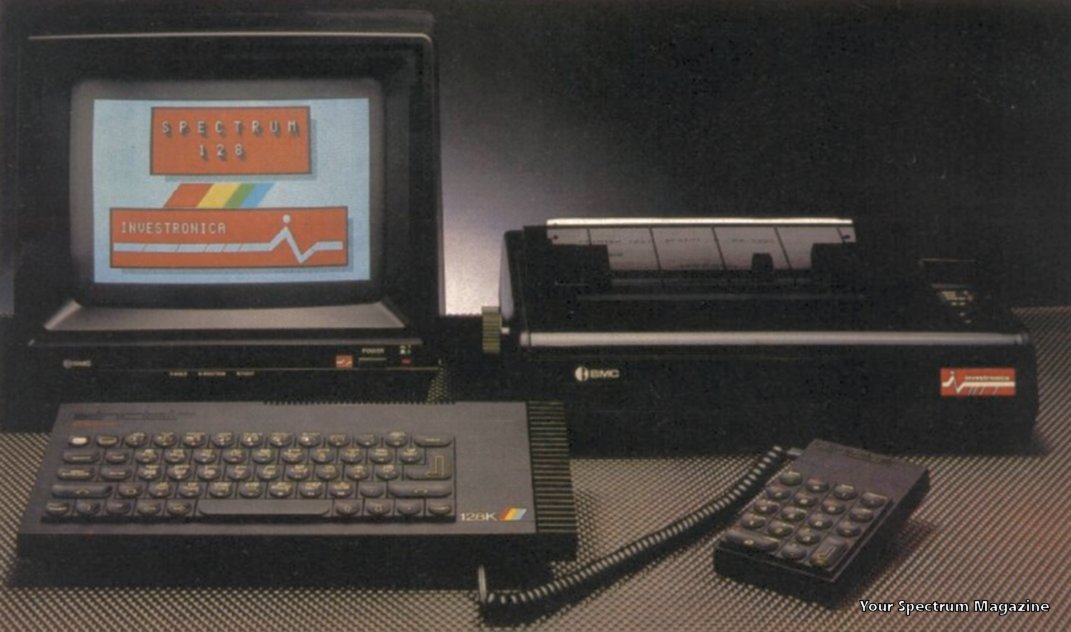
In September 1985, Sinclair Research launched the ZX Spectrum 128K in Spain, introducing the first major expansion of the Spectrum's hardware since the original machine appeared in 1982. Developed jointly with Spanish distributor Investrónica under the code name "Derby", the new computer was designed to meet the requirements of the Spanish market and was first presented at the Sonimag trade fair in Barcelona.

The most important change was the increase in memory from 48K to 128K. Because the Z80 processor could only directly address 64K of memory, Sinclair used a bank-switching system to divide the additional RAM into 16K banks. The machine also contained 32K of ROM and introduced an enhanced version of Sinclair BASIC with a new editing system.

The 128K brought several other significant improvements. An AY-3-8912 sound chip provided three-channel music and sound, while the computer gained an RGB monitor connection, RS-232 serial interface and MIDI capability. It could also operate in a 48K compatibility mode, allowing existing Spectrum software to continue to be used. The distinctive external heatsink running along the side of the case led to the machine acquiring the affectionate nickname "Toastrack".

Although the Spanish machine appeared in 1985, British customers had to wait until January 1986 for the ZX Spectrum 128K to go on sale in the UK. The UK version was priced at £179.95 and omitted the external numeric keypad supplied with the Spanish version. It was the last Spectrum to be released by Sinclair Research before the computer business and Sinclair brand were acquired by Amstrad in 1986.
Source: Sinclair User
The ZX Spectrum 128K, code-named Derby, was jointly developed by Sinclair Research and Spanish distributor Investrónica. It was launched in Spain in September 1985, ahead of its UK release.
Page Revised: 02/09/2026